
Super Typhoon Sinlaku Rapidly Intensifies Over the Pacific, Outer Bands Reach the Mariana Islands
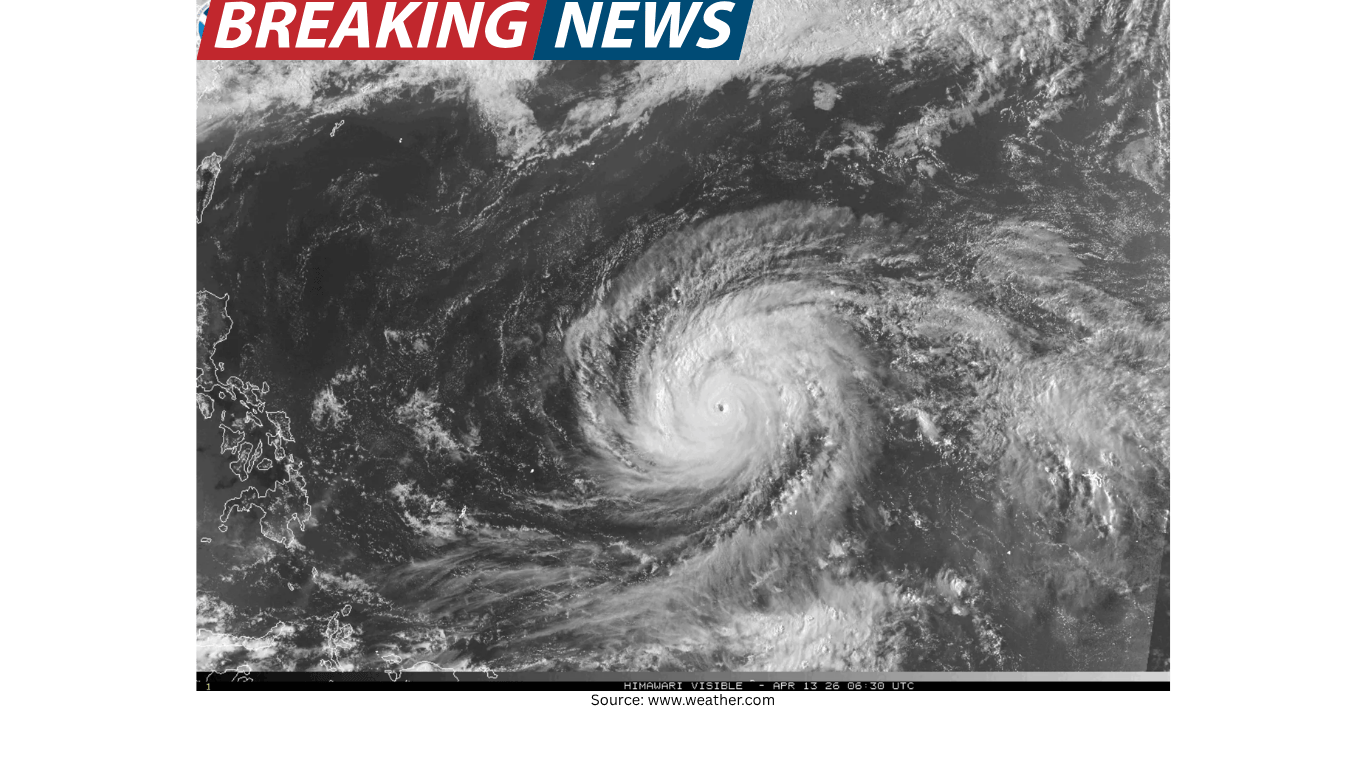
A rapidly strengthening storm in the Pacific
Super Typhoon Sinlaku has undergone rapid intensification over the Pacific, drawing attention for both its structure and its reported strength. Satellite imagery has revealed a massive system with a well-defined eye—an indicator often associated with a highly organized tropical cyclone. According to the available details, sustained winds have reached 180 mph, placing Sinlaku among the most intense storms observed so far in 2026.
Rapid intensification is a term used when a tropical cyclone strengthens significantly over a short period of time. In practical terms, it means a storm can go from dangerous to extreme faster than many people expect, leaving less time for preparation. In Sinlaku’s case, the key point is the speed and scale of its strengthening, paired with imagery that shows a large, clearly formed eye at the center of the circulation.
While the storm’s core remains out over the Pacific, its reach is already extending outward. The outer rain bands have begun to lash the Mariana Islands, signaling that impacts can occur well away from the center. Even when the eye is not nearby, these bands can bring squally weather, periods of heavy rain, and gusty winds, depending on how they move through the region.
What the satellite imagery is showing
One of the most striking elements of Super Typhoon Sinlaku has been the satellite presentation. The storm has been described as having “stunning satellite imagery,” featuring a massive, well-defined eye. For observers, a clearly visible eye can be an unmistakable sign of a mature, powerful cyclone with a tightly organized inner core.
The eye is essentially a calmer region at the center of the storm, surrounded by the eyewall—a ring of intense thunderstorms where the strongest winds and heaviest precipitation are typically found. A well-defined eye often indicates that the storm’s internal structure is coherent and stable enough to sustain extreme winds. In Sinlaku’s case, the combination of a large storm footprint and a distinct eye underscores how organized the system has become.
Satellite imagery is also valuable because it provides a continuous, wide-area view of the storm’s evolution. It can highlight changes in the eye, the symmetry of the surrounding cloud shield, and the development of outer bands. For a rapidly intensifying system, these visuals can help communicate the storm’s severity even to people who are not meteorologists.
Reported intensity: sustained winds near 180 mph
The available information states that Sinlaku has reached sustained winds of 180 mph. That figure, if maintained, reflects an exceptionally intense tropical cyclone. Winds of this magnitude are associated with catastrophic potential near the eyewall and in the immediate vicinity of the storm’s core.
It is important to distinguish between the storm’s maximum sustained winds and the conditions that may be experienced in locations affected by the outer bands. The strongest winds are typically concentrated near the center, while outer bands can produce variable conditions that may include strong gusts and bursts of heavy rain. Even so, the presence of outer bands lashing the Mariana Islands indicates that the storm’s influence is already being felt beyond its inner core.
Because the storm is described as rapidly intensifying, close monitoring is especially important. Rapid changes in intensity can alter the expected severity of impacts and can influence how people interpret risk, particularly in areas that may first experience only intermittent banding and then see conditions deteriorate if the storm’s track or structure changes.
Outer bands begin affecting the Mariana Islands
As Sinlaku continues over the Pacific, its outer bands have started to lash the Mariana Islands. Outer bands are typically curved lines of thunderstorms that spiral around the center of a tropical cyclone. They can extend far from the eye and can arrive in waves, producing periods of unsettled weather separated by relative lulls.
For communities in the Mariana Islands, the onset of banding can be an early signal that a major system is nearby, even if the center remains at a distance. Banding can bring changing wind directions, sudden gusts, and bursts of heavy rainfall. Conditions can also vary significantly from one island to another depending on how individual bands move through.
The key detail here is that impacts have begun at the periphery of the storm. That matters because it illustrates how a large, intense cyclone can influence weather well away from the eye. It also reinforces why storms like Sinlaku are tracked not only for where the center may go, but for how broad the storm’s circulation and rain field may be.
Track outlook: a system being closely watched
The storm is described as being “on track to potentially become the strongest system of 2026 so far.” That phrasing reflects both its current intensity and the possibility that it could maintain or even exceed that strength as it continues. While the available information does not provide a detailed forecast path beyond the mention of the Mariana Islands being affected by outer bands, the overall message is that Sinlaku is a high-end tropical cyclone that warrants attention.
In public communication, storms that reach this level of intensity tend to be monitored not only for their immediate impacts but also for how quickly conditions can change. The combination of rapid intensification and a well-defined eye suggests a storm that has become highly organized in a relatively short time.
Even without additional specifics on timing or exact track, the presence of outer bands over the Mariana Islands indicates that the storm’s circulation is already interacting with the region. For residents and travelers, that typically means paying close attention to official updates as conditions evolve.
Why rapid intensification matters for forecasting and awareness
Rapid intensification is one of the most challenging aspects of tropical cyclone forecasting because it can compress the window for preparation. A storm that strengthens quickly can outpace expectations, especially for those who may be tracking it casually or relying on earlier projections.
Sinlaku’s rapid intensification, as described, is paired with clear satellite indicators of a powerful storm: a massive structure and a well-defined eye. Together, these elements can serve as a visual and meteorological signal that the system has reached a level of organization consistent with extreme intensity.
For the public, rapid intensification also affects perception. People may see early reports of a storm and assume they have time, only to learn later that the storm has strengthened dramatically. In Sinlaku’s case, the reported jump to sustained winds of 180 mph highlights how quickly a cyclone can become a major threat.
Understanding what “outer bands” can bring
While the most severe conditions are typically near the eyewall, outer bands can still produce hazardous weather. These bands can contain thunderstorms capable of producing strong gusts and heavy downpours. They may also cause rapidly changing conditions, with one band bringing a burst of intense weather followed by a lull before the next band arrives.
The mention that the outer bands are lashing the Mariana Islands is significant because it indicates that the storm’s influence is already present. For many storms, the first impacts are often felt through these bands rather than through the core. This can be especially relevant for large systems, where the distance between the outermost bands and the eye can be substantial.
Another aspect of outer bands is their uneven distribution. Some areas may see repeated bands and prolonged periods of squalls, while others may experience shorter, more intermittent impacts. That variability can make it difficult for individuals to judge the broader risk based solely on what they see at a given moment.
What makes Sinlaku stand out in 2026 so far
Sinlaku is being discussed in the context of potentially becoming the strongest system of 2026 so far. The basis for that attention is its rapid intensification, the satellite depiction of a massive, well-defined eye, and the reported sustained winds reaching 180 mph.
When storms reach such intensity, they often become reference points for the season or year, not only because of their peak winds but because of their structure and the speed at which they evolve. Sinlaku’s presentation—particularly the clearly defined eye—has been highlighted as a notable feature.
In addition, the fact that outer bands are already affecting the Mariana Islands underscores the storm’s reach. Even when the most extreme conditions remain offshore, the broader circulation can still produce meaningful impacts in nearby regions.
Key points at a glance
Super Typhoon Sinlaku has rapidly intensified over the Pacific.
Satellite imagery shows a massive storm with a well-defined eye.
Sustained winds have been reported at 180 mph.
Outer bands have begun lashing the Mariana Islands.
The storm is being watched for its potential to become the strongest system of 2026 so far.
Staying focused on updates as conditions evolve
With a storm described as rapidly intensifying and already sending outer bands into the Mariana Islands, the situation is dynamic. The most important takeaway from the available information is that Sinlaku is an exceptionally intense, highly organized tropical cyclone over the Pacific, and its impacts are beginning to be felt at the edges of its circulation.
As the storm continues, attention will remain on its intensity trends and the progression of its bands and core. The combination of a well-defined eye, extreme sustained winds, and expanding impacts through outer bands is why Sinlaku is being closely watched in the broader context of 2026’s tropical activity.
For those in areas experiencing the outer bands, the onset of squally weather can be a reminder that a storm’s effects do not begin only when the center arrives. In large, powerful systems like Sinlaku, the first signs can come in waves—sometimes well before the most intense part of the storm is anywhere nearby.