
Southeast Drought Intensifies Ahead of Summer, Raising Heat, Fire and Water Concerns
A spring defined by dryness, not storms
Spring across the Southeast is often associated with frequent rain, thunderstorms and bouts of severe weather. This year, however, a different story has taken hold: drought has become the defining concern as the region moves closer to summer.
The shift is not subtle. Drought conditions have expanded and intensified across the Southeast, and the worsening trend is drawing attention because it arrives at a time of year when many communities and visitors typically expect more consistent rainfall. Instead, the region is confronting a dry spring on top of a dry winter, with impacts that are already being felt and may grow more pronounced in the months ahead.
How widespread is the drought?
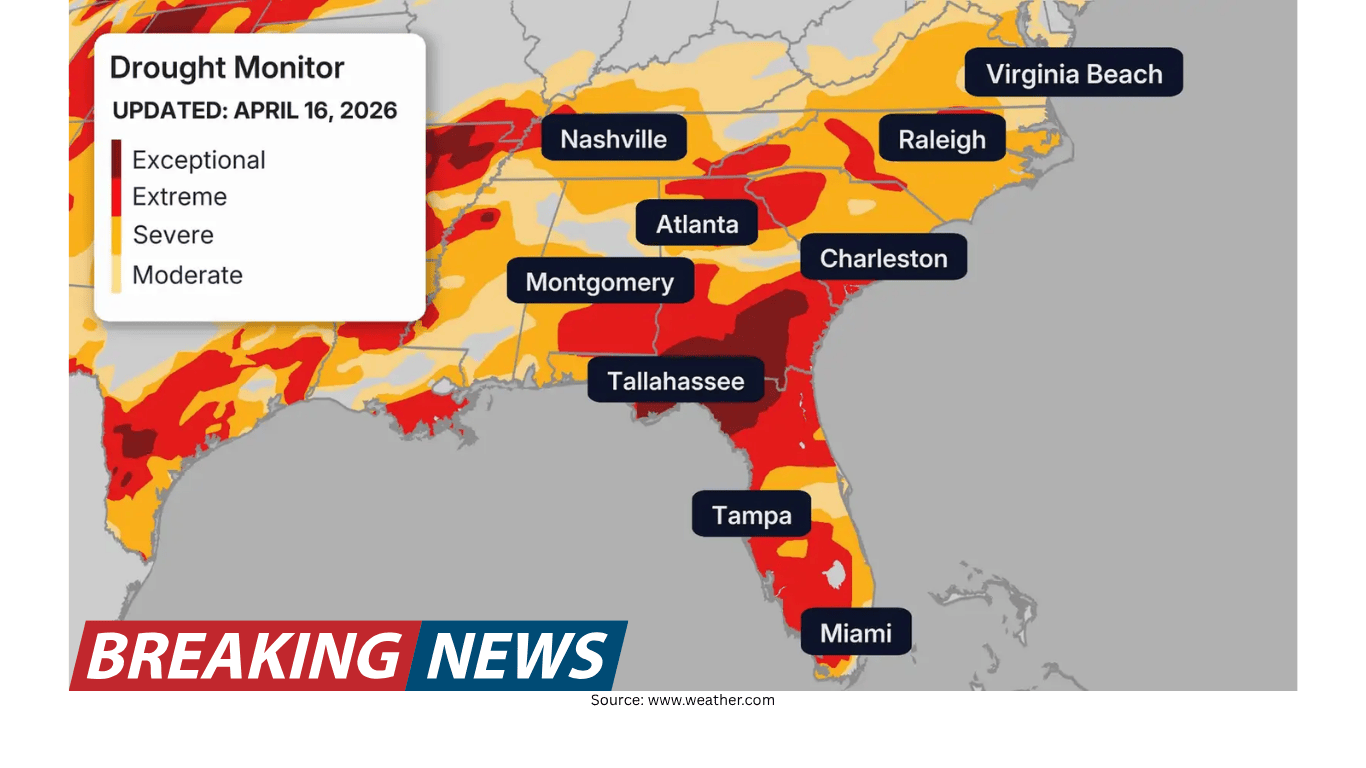
The drought has expanded and worsened across the Southeast, with the areas categorized as severe and extreme drought increasing by about 10% in each category. On its face, a 10% change might sound modest. In context, it is significant because nearly the entire region is already in drought, meaning the increase represents a broad intensification rather than an isolated pocket of worsening conditions.
In practical terms, the drought footprint now covers essentially the whole Southeast. Every part of Georgia, South Carolina, North Carolina, Virginia, Tennessee and Alabama is experiencing drought conditions. Arkansas and Florida are each at 99% in drought. Florida, in particular, is experiencing its worst drought in 25 years.
This level of coverage matters because it reduces the number of “buffer” areas that can provide relief—whether through shared water resources, agricultural supply chains, or simply nearby locations where conditions are less strained. When drought is nearly region-wide, the effects can be more synchronized and harder to offset.
Not a sudden development: dry conditions date back to last fall
Although the drought is top of mind now, it did not develop overnight. The Southeast has been dealing with drought conditions since last fall, and the accumulated deficits are part of why the current situation is so concerning heading into summer.
According to drought monitoring reporting, several states experienced record dry conditions during the period from September 2025 through March 2026, with records dating back to 1895. Georgia, North Carolina and South Carolina were among those with record dry conditions for that September–March window. Over the same period, September–March ranked as the second driest for Alabama, the third driest for Florida, the ninth driest for Tennessee, and the 10th driest for Virginia.
These rankings underscore that the current drought is not simply the result of a few rain-free weeks. It reflects months of below-normal precipitation, which can be especially difficult to reverse quickly because soils, vegetation and water systems often need sustained rainfall—rather than a single wet spell—to recover.
Why it happened: the winter pattern and a dry spring
The broader weather pattern helps explain how the region arrived at this point. The United States was under the influence of a La Niña pattern this past winter. This type of pattern typically results in a warmer and drier winter in the Southeast, and that is what occurred. The winter dryness then transitioned into a dry spring, compounding the precipitation shortfall.
Many major cities are currently experiencing one of their top 10 driest spring seasons to date, based on regional climate reporting. The list includes Atlanta, Savannah, Tallahassee, Charleston, Charlotte, Raleigh, Richmond, Memphis, Nashville and Montgomery.
When large population centers experience unusually dry seasons at the same time, the impacts can ripple outward. Water demand tends to increase as temperatures rise, and dry conditions can stress vegetation and soils earlier than usual—conditions that can set the stage for a more challenging summer.
Near-term forecast: some rain, but not enough to end the drought
There is some short-term relief in the forecast: a pattern change is expected to bring a bit of rain to the parched Southeast over the next seven days. The key phrase, however, is “a little bit.”
Areas experiencing the worst drought—especially Florida and Georgia—may see only about a half inch of rain or less during that period. Other areas could fare somewhat better. Forecast totals of 1 to 3 inches are expected for parts of the Tennessee and Mississippi Valleys, which would help ongoing drought conditions but would not be enough to qualify as a “drought buster.” Arkansas may see higher amounts, with model guidance hinting that parts of the state could receive up to 5 inches.
Even when rain arrives, its ability to improve drought conditions depends on duration, intensity and how much of the region benefits. A short burst of heavy rain can produce runoff without fully replenishing soil moisture, while lighter, steadier rain tends to soak in more effectively. The forecast described suggests that while some locations may gain meaningful short-term relief, the hardest-hit areas may not receive enough precipitation to significantly change the overall drought picture.
Seasonal outlook: drought expected to worsen into summer
Looking beyond the next week, the outlook remains troubling. The current projection indicates the drought will worsen as the region heads into the summer months, particularly in places such as Atlanta, Charlotte, Raleigh, Montgomery and Richmond.
One reason this matters is that summer is already a hot season across the Southeast. If drought intensifies, the region could see a summer that ends up hotter than average in an already hot part of the country. While heat can be a concern on its own, it also interacts with drought in ways that can amplify impacts: hotter air can increase evaporation, dry out soils further, and stress vegetation.
In addition, drought is not easily erased. According to NOAA, much of the Southeast would need roughly 15 to 25 inches of rain over a three-month period to eliminate the drought completely. That figure illustrates the scale of the precipitation deficit and why a brief rainy stretch—while welcome—may not be enough to reverse conditions by itself.
Wildfire risk: dry fuels, low humidity and wind can combine quickly
One of the most immediate concerns tied to expanding drought is wildfire danger. With dry fuels, hot weather and low relative humidity, the risk of fires can increase. Gusty winds can also fan flames easily, turning small fires into fast-moving threats.
The Southeast is already seeing the consequences of these conditions, including destructive wildfires that have impacted communities. Drought does not cause every fire, but it can create an environment where fires start more easily and spread faster.
For residents and travelers, this is not just an abstract seasonal hazard. If you are vacationing in a drought-stricken part of the Southeast and are not familiar with wildfires, it is advised to have a plan in place in case an evacuation becomes necessary. In regions where wildfires are less common in the public imagination, people may underestimate how quickly conditions can change, particularly when wind and very dry vegetation are involved.
Soil moisture and agriculture: a less visible but critical impact
Drought is not only about rainfall totals; it is also about what is happening in the ground. Soil moisture across the Southeast is very low, a condition that directly affects agriculture. When soils are dry, crops and other vegetation can struggle, and the timing matters: dryness heading into the warm season can place stress on plants just as temperatures rise.
Low soil moisture can also have broader implications beyond farms. Dry soils can contribute to hotter local conditions because less energy goes into evaporating moisture and more goes into heating the surface air. While the specifics vary by location and weather patterns, the overall relationship between dry ground and heat is one reason drought can be associated with hotter conditions during summer.
Water levels and restrictions: what communities may face
Low water levels have already led to some water restrictions, particularly in parts of Florida. Restrictions can vary by locality, but they often reflect a simple reality: when rainfall has been scarce for months, water supplies can be strained, especially as seasonal demand increases.
For households and businesses, restrictions can affect outdoor water use and other activities tied to warm-weather routines. For visitors, they can shape expectations for lodging, recreation and local guidance on water use. The presence of restrictions is also a signal that drought impacts are moving beyond meteorological charts and into daily life.
What this could mean for summer travel
As the Southeast heads into summer, drought conditions could influence travel in several ways. The most direct concerns relate to heat and wildfire risk. A hotter-than-average summer is possible, and fire danger may increase where fuels are dry and humidity is low.
Travelers planning trips to drought-stricken areas should be mindful that conditions can change quickly, particularly during periods of wind or very low humidity. While many vacations proceed normally even during drought, the combination of heat, dry landscapes and the potential for wildfire smoke or fire activity can affect outdoor plans.
Because the drought is so widespread—covering nearly the entire region—travelers may find that the impacts are not confined to one state or one corridor. That makes it more important to monitor local conditions in the specific places you plan to visit, especially if your plans include outdoor recreation.
Key points at a glance
- Drought has expanded and worsened across the Southeast, with severe and extreme drought coverage increasing by about 10% in each category.
- Every part of Georgia, South Carolina, North Carolina, Virginia, Tennessee and Alabama is in drought; Arkansas and Florida are 99% in drought.
- Florida is experiencing its worst drought in 25 years.
- A La Niña pattern contributed to a warmer, drier winter, followed by a dry spring.
- Several major cities are experiencing one of their top 10 driest spring seasons to date, including Atlanta, Savannah, Tallahassee, Charleston, Charlotte, Raleigh, Richmond, Memphis, Nashville and Montgomery.
- Some rainfall is expected over the next seven days, but the hardest-hit areas may see only about a half inch or less, and the broader outlook still shows worsening drought into summer.
- NOAA estimates much of the Southeast would need about 15 to 25 inches of rain over three months to eliminate the drought completely.
- Fire danger is expected to increase with dry fuels, hot weather, low humidity and gusty winds; travelers are advised to have an evacuation plan if visiting drought-stricken areas.
- Soil moisture is very low, affecting agriculture, and some water restrictions have been reported, particularly in parts of Florida.
Watching the weeks ahead
The Southeast is entering a critical period. With drought already widespread and projections calling for further worsening into summer, the region’s near-term rainfall will help at the margins but is unlikely to erase the larger deficit. The combination of low soil moisture, the potential for hotter-than-average conditions, and heightened wildfire risk creates a set of challenges that can affect residents, agriculture and travelers alike.
For now, the most important takeaway is that drought conditions are not only extensive but also deepening in key areas. Any rain in the coming days may provide temporary relief, yet the longer-term outlook suggests the Southeast will continue to grapple with drought as summer approaches.