
Why a Key Atlantic Ocean Current May Slow Sooner Than Expected
A major ocean “conveyor belt” under new scrutiny
A vast ocean current system in the Atlantic Ocean plays an outsized role in shaping weather and climate patterns far beyond the sea itself. Scientists have long expected that this system would weaken as the planet warms, but new research suggests the slowdown could be sharper—and could approach critical thresholds sooner—than many earlier projections indicated.
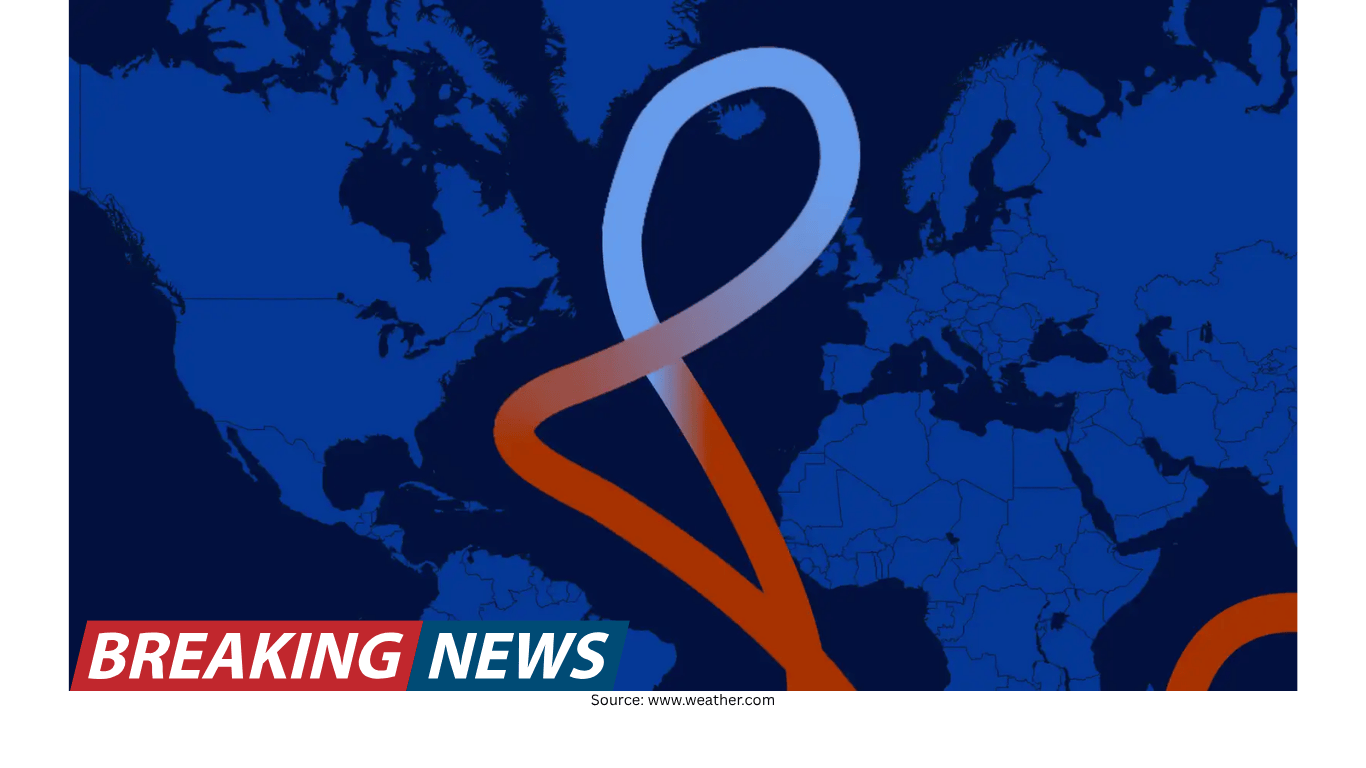
The system is known as the Atlantic Meridional Overturning Circulation, or AMOC. It is often described as a conveyor belt: warm, salty water travels northward near the ocean surface from the tropics, while colder, denser water returns southward at depth. This continual exchange helps distribute heat around the planet, influencing global temperatures and rainfall patterns.
According to research published in Nature, the AMOC could slow by as much as 50% by 2100. That estimate is more pronounced than many previous projections and adds urgency to questions about how quickly impacts may unfold—and how disruptive they could be for regional weather, coastal risks, ecosystems and the global climate system.
How the AMOC works—and why it matters
To understand why scientists pay close attention to the AMOC, it helps to focus on its basic mechanics. In the Atlantic, warm surface water moves northward. Over time, that water cools, becomes denser and sinks, helping drive a deep return flow southward. The overall circulation acts as a powerful mechanism for moving heat from one region to another.
This redistribution of heat is not a niche oceanographic detail. It is part of the broader climate system that helps set the stage for weather patterns, including where storms tend to track and how rainfall is distributed across seasons. Because the AMOC influences how heat is stored and transported in the ocean, changes in its strength can ripple into the atmosphere and affect conditions on land.
If the AMOC slows, the balance of heat transport changes. One simplified way to picture it is this: less warm water would be carried northward, meaning more warmth would remain closer to the tropics while cooler conditions would persist farther north. Even without a complete shutdown, a substantial weakening can reshape regional temperature contrasts and the patterns that depend on them.
What the new research suggests about the pace of change
Climate models have for years pointed in the same general direction: as the planet warms, the AMOC weakens. What has been less consistent is the projected speed and magnitude of that weakening. Estimates have varied widely, leaving uncertainty about the timeline for significant impacts.
The new study sought to narrow that uncertainty by combining model simulations with real-world observations. The observations include patterns in ocean temperature and salinity—key variables because they influence seawater density and the sinking of cold, dense water that helps drive the circulation.
One of the study’s notable implications is that the decline may not be smooth or easily predictable. Rather than a steady, gradual weakening, the system could approach critical thresholds earlier than expected. That raises the risk of abrupt changes—shifts that occur more quickly than societies and ecosystems can easily adapt to.
Researchers still consider a full collapse of the AMOC within this century unlikely. However, the study underscores that even a large slowdown—short of collapse—could have far-reaching consequences.
Potential consequences: sea level, storms and regional temperature shifts
The effects of a weaker AMOC would not be uniform. Different regions could experience different—and sometimes counterintuitive—changes. The study and related scientific discussion highlight several areas of concern.
U.S. East Coast sea level rise: Along the U.S. East Coast, changes in ocean circulation linked to a weaker AMOC could contribute to faster sea-level rise. Higher sea levels increase the risk of coastal flooding, particularly during high tides and storm events.
Storm tracks and storm intensity: Altered temperature patterns across the Atlantic basin can influence storm tracks. Changes in where storms travel and how they intensify can affect coastal communities and inland regions that depend on predictable seasonal patterns.
Europe’s regional temperatures: In Europe, a weaker AMOC could counteract some aspects of global warming, leading to cooler regional temperatures—especially in northern areas. This does not negate global warming overall, but it highlights that regional outcomes can differ from the global average.
Tropical rainfall and monsoon systems: Shifting ocean heat patterns could disrupt rainfall in the tropics. The study notes the potential for changes that could alter monsoon systems that billions of people rely on, a reminder that ocean circulation connects to water supply and agriculture far from the North Atlantic.
In practical terms, these shifts could touch many parts of daily life: water supplies, farming decisions, infrastructure planning and disaster preparedness. When the underlying patterns that guide rainfall and temperature change, the risks are not limited to a single sector.
Polar temperature contrasts: cooling in the Arctic, warming in the Antarctic
One of the more striking possibilities raised in the research involves polar temperature changes. Scientists suggest that if the AMOC slows, temperatures in the Arctic could cool by nearly 11 degrees Fahrenheit (6 degrees Celsius), while the Antarctic could warm by more than 12 degrees Fahrenheit (7 degrees Celsius).
These contrasting changes underscore how interconnected the ocean system is. A shift in Atlantic circulation is not merely a North Atlantic story; it can influence how heat is redistributed across the globe, affecting distant regions in different ways.
The ocean’s role in the carbon budget
The AMOC is not only a heat-transport system. The ocean is also a vital carbon reservoir, having absorbed roughly a quarter of carbon dioxide emissions over the decades. Changes in ocean circulation can therefore intersect with the planet’s carbon budget.
The research notes that a change in circulation could create problems for the carbon budget and warm the planet as a whole by about 0.36 degrees Fahrenheit (0.2 degrees Celsius). While that number may sound modest, it is presented as an additional warming influence on top of broader warming trends—an important detail when scientists and policymakers consider cumulative impacts.
Why earlier projections may have underestimated the slowdown
A key question is why the new findings differ from some earlier projections. One explanation suggested by scientists involves subtle biases in how models simulate ocean conditions. Small errors in salinity and temperature—especially in key regions of the Atlantic—can have outsized effects on how dense water moves and sinks. That sinking process is a critical driver of the AMOC.
In other words, even minor mismatches between modeled and real ocean conditions can translate into significant differences in how models represent the circulation’s strength and stability. By combining simulations with observations of temperature and salinity patterns, the new research aims to reduce that uncertainty and better capture the system’s vulnerability.
What we can—and can’t—measure directly
Despite the growing body of research, scientists face a fundamental challenge: direct measurements of the AMOC span only the past couple of decades. That limited record makes it difficult to determine exactly how the current strength compares with long-term historical levels, and how close the system may be to a tipping point.
Even so, there are signs the AMOC has weakened compared to its historical strength. The combination of observed changes and updated modeling adds to evidence that this part of Earth’s climate system may be more vulnerable than once thought.
Why this matters for forecasting and long-range planning
Weather forecasting and climate planning often depend on assumptions about the stability of large-scale patterns. The AMOC is one of those foundational patterns. If it weakens substantially, it could alter the background conditions that shape seasonal outlooks, long-term rainfall expectations and regional temperature norms.
For decision-makers, the importance lies less in any single projection and more in the range of plausible outcomes. A slowdown approaching 50% by 2100, combined with the possibility of earlier critical thresholds, suggests that planning based solely on gradual change could be risky. Infrastructure, agriculture and coastal management strategies may need to account for the possibility of faster shifts in sea level, storm behavior and rainfall distribution.
A system with global reach
The AMOC’s influence extends from the tropics to the poles, and from the ocean to the atmosphere. The new research does not claim that an abrupt collapse is the most likely near-term outcome, but it does sharpen the picture of meaningful weakening within this century and highlights the potential for earlier-than-expected thresholds.
Ultimately, the study reinforces a core message of climate science: the planet’s major systems are interconnected. A change in the Atlantic’s circulation can affect coastal flood risk along the U.S. East Coast, temperature patterns in Europe, rainfall in the tropics and even the balance of heat between the Arctic and Antarctic. As scientists continue to refine models and expand observations, the AMOC will remain a key indicator to watch for understanding how global warming may reshape weather patterns around the world.